You Might Also Like

Showing posts with label Davao. Show all posts

Bonsai Fields of Mt. Hamiguitan


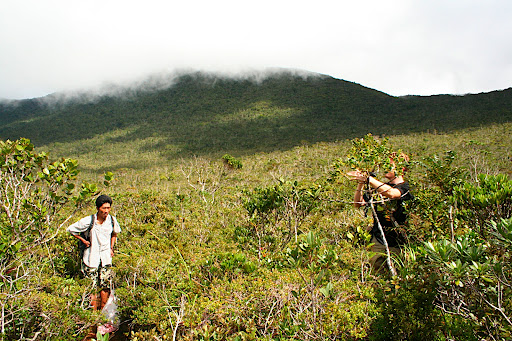
Truly one of Mother Nature's gifts to the Filipino people, the Bonsai fields of Mt. Hamiguitan, which is situated no less than 5,345 feet above sea level, consists of more than 1,000 hectares of forest life filled with wild and exciting flora and fauna. As the name suggests, Bonsai trees span most of the given area.

These century-old trees stand 2-3 feet tall, with the tallest reaching only 5 feet in height, and are so sturdy that one can literally carry the weight of a man on its branches. It is like finding oneself suddenly in a veritable enchanted garden right in the middle of the jungle. Also located at Barangay La Union, this wonder has already been featured in Magandang Gabi Bayan for its uniqueness and mystical quality.

The area is also a sanctuary of rare and exotic birds and animals, including the world famous Philippine Eagle. Because of its beauty and charm, the mountain has become a favorite camping site of many local and foreign tourists, mountaineers, enthusiasts, biologists, ornithologists, and adventure loving people.


Bags Ready for Distribution, Free School Supplies for Grade-I Pupils in Lupon


Mayor Domingo A. Lim today said that free school supplies and bags regularly provided by the Local Government to the Grade - I public schoolchildren are all set for distribution upon the start of this school year.

Lim said his Staff has already started to deliver the free education materials to the public elementary schools, located in the barangays, in time for distribution during the opening of classes on June 8.


The mayor said the deliveries also cover the 21 barangay schools including the 3 hinterland barangays of DONCAMAR (Don Mariano Marcos, Calapagan and Marayag).


The distribution of free school supplies and bags is an annual undertaking of the local government that began in his term, in line with the LGU's commitment to help parents cope with the rising costs of education materials.

Davao Oriental Farm Villages Protest Small-Scale Mining


Residents of Banaybanay and Lupon town have joined hands with environmentalists in raising alarm over the proliferation of small-scale mining operations in a mountain village near the Compostela Valley boundary.

The Save Sumlog River Alliance (Sasura) called on Gov. Corazon Malanyaon to stop mining operations in the sitios of Anogkot and Tabon in Barangay Marayag, a hinterland village in Lupon town.

Sasura chair Felix Mejos said here Thursday his group was also asking Malanyaon to declare over 44,000 hectares of land near the Sumlog watershed as a protected area.

“Mine wastes from tunnels are dumped into the river, making the water level shallow and lacing it with mine toxic wastes,” Mejos said.
Mejos, who is also head of a farmers’ association in the town, led a party of environment advocates, local officials and journalists on a fact-finding mission to the area.

“It was an appalling sight,” he said. Logs were strewn all over and mine wastes had turned the river brown.

Mejos said at least 50 small-scale operators formed a cooperative to mine the area, but unregistered miners also thrive there.

Mejos said concerns about the dangers of mining in the area had been raised since last year, prompting the towns of Lupon and Banaybanay to pass resolutions asking the provincial government of Davao Oriental to ban mining.

Local officials also feared that continued mining in the area would destroy the Sumlog watershed and cause an environment calamity.
“We need to act together now,” town councilor Liezel Teves said.

Edwin Tagara, a 47-year-old farmer from Barangay Rang-ay here, said his yield fell to 80 sacks per hectare in the last cropping season compared to his previous harvest of 120 bags because chemical wastes like cyanide and mercury, which are being dumped on the river from the mining site, found their way into his farm.


Davao-Lupon fastcraft set for maiden voyage


IF SCHEDULES permit, the 2009 Caracoles Festival will feature the maiden voyage of the 150-seater fastcraft that will service the Santa Ana wharf to Lupon route.

According to Araceli Ayuste, Caracoles festival chair, she was able to talk last week to Dante Sipalo, the franchisee of the Fastcraft service, who is a Lupon-born and Manila-based businessman.

Sipalo has informed her that the fastcraft has just left its shipyard in Japan en route to Cebu for defouling and could possibly be in Davao during the Caracoles.

Ayuste hopes that the ship will be in Davao, in time for the Caracoles festival, which is a regional event that celebrates the beauty and the bounty of Davao Gulf. It is the culminating event of the Dive the Gulf festival and will highlight a sundown-to-sunrise party to be held at the Santa Ana wharf.

Ayuste expressed hopes they can promote the fastcraft in the festival. The sea-borne transportation hopes to entice commuters who wish to avail of a much faster one-hour trip to Lupon, which normally takes two hours by bus. Fastcraft fare is three hundred pesos for every trip.

She also said that there are actually two fastcrafts: the bigger fastcraft will be the one utilized for public utility transport while the smaller craft will be available for chartered tours. The fastcraft service, she said, can help in tapping the tourist potentials of Davao Gulf. (PIA)

Davao Museum


About seven miles (12km) from the Davao City center at Insular Village, Lanang, the Davao Museum is devoted to showcasing the various tribal cultures of the people of the region. The main gallery is a repository of tribal art, local costumes, jewelry, ceramics and handcrafts. There is also a gallery of paintings, sculptures and ceramics, and a souvenir shop sells native crafts. Tribal women can be seen at work at the nearby T’Boli Weaving Center weaving cloth from the fibers of the native abaca plant, featuring patterns that depict the folklore of the tribe.

Address: Zonta Bldg, Insular Village Phase I, Lanang
Hours: Monday to Saturday from 9am to 5pm

Philippine (Monkey Eating) Eagle


The Philippine monkey-eating eagle is well named for its preference for eating monkeys, particularly macaques.

This ferocious-looking bird stands over 3 feet (1 m) tall and can weigh up to 9 pounds (4 kg) -- larger than a golden eagle. Bluish eyes, a large, sharp, curved beak, and a warlike headdress of spiky feathers, give the Philippine eagle a striking appearance.

First described in 1894 in the Philippines, the total wild population of the Philippine eagle is now estimated to be under 200. Once found in thick, mountainous forests on most of the larger Philippine islands, the eagle has been extirpated from several islands just in the last 20 years.

The Philippine eagle also attacks domestic animals such as dogs, pigs, and young goats.

Like most big predators, the Philippine eagle requires a large territory for hunting. Philippine eagles also require the tallest trees, those which emerge above the rain forest canopy, for nesting. They have a very low reproduction rate, laying just one or two eggs each year.

Hunting of and trade in the Philippine eagle are now prohibited. The greatest threat to its survival remains the continued loss of its tropical rain forest habitat. At a minimum, selective logging methods should be employed to protect the large nesting trees and leave sufficient tracts of undisturbed forest to support eagles.

In addition, the use of agricultural pesticides needs to be reduced to prevent poisoning of animals at the top of food chains.

Advertisements

Advertisements